

 Español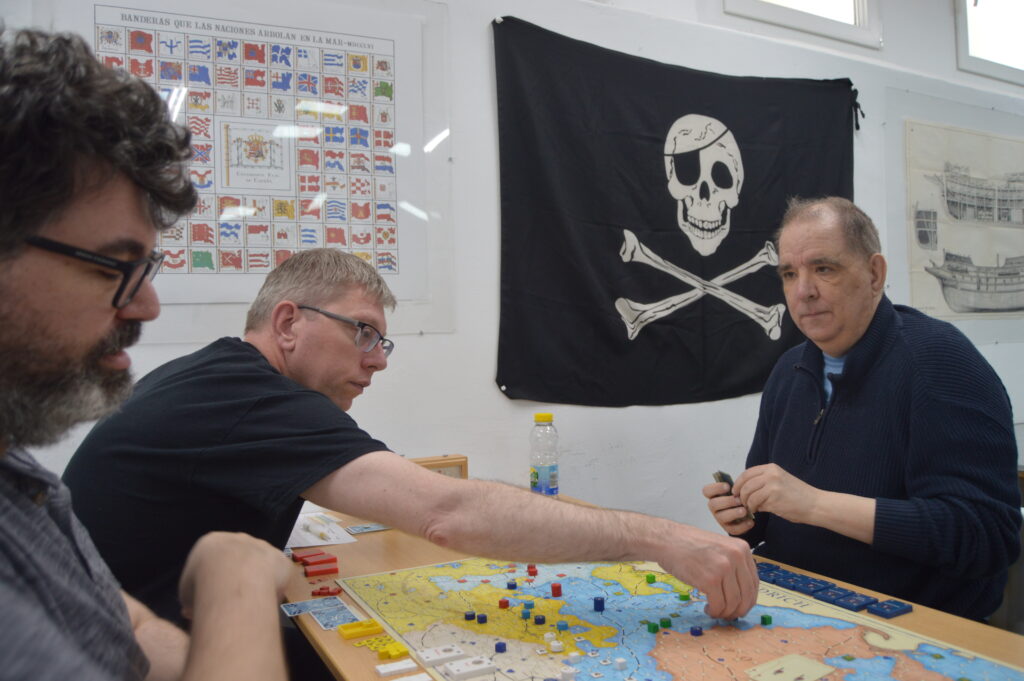
Loughlin places a marker on the board while Björn keeps his attention focused on Jorge’s moves.
Table 1
Prussia – under the command of Bjorn v. Knorring – used a strategy that was repeated often during this tournament: he took a Hanoverian general and deployed it in Saxony in support of Prussia’s defence against Austria. At the same time he was sepndeing most of his cards and troops against Austria in diamonds at Silesia. Jorge’s triple white tower quickly attritioned Bjorn’s hand out of diamonds and this forced Schwerin and Keith to escape to Saxony via Bohemia thanks to a cunningly place supply train and then prepared his last ditch defense at Saxony.
Meanwhile, Jesús (O.o.c. player) used a strategy that was both unusual and – eventually – succesful. He concentrated all four Russian generals on taking East Prussia first, and when one of these was taken off board, he didn’t bother to buy it back, thus playing with just 3 generals for most of the game and achieving ajoint victory with Jorge’s Austrians on round 15. Loughlin was able to make effective pressure on Prussia, but found tougher resistance.
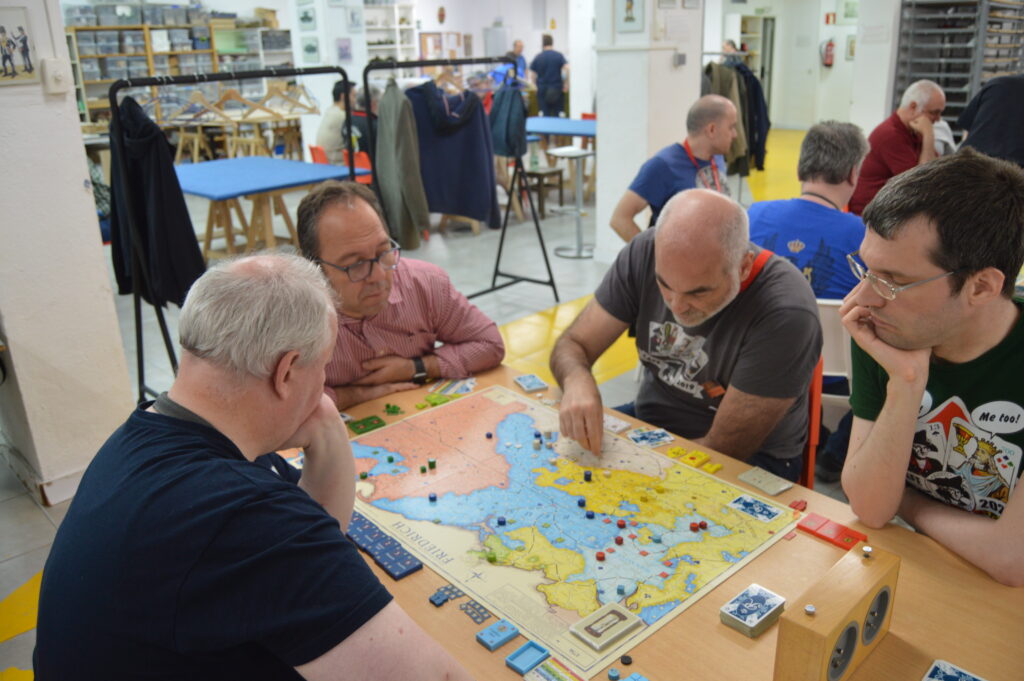
Players at the table attentively wait for Alex to finish his moves.
Table 2
Austria decided from the very beginning of this fame to go all out for Saxony and an Imperial victory. This made Magdeburg’s defence before the French rather difficult and it fell early to Andrew Brown’s red pieces as he chose to leave the Hanoverians unharmed on his rearguard. In the East Maurice’s Prussians also gave ground very quickly and then held his ground against the Russians in the hearts sector at Küstrin. He was also able to hunt down and destroy Hildi, which put an end to Alex Calderón attempt with the Empire and thus brought about a radical strategy change for the Austrians, with whom he just merely tried to score as many pòints as possible in Silesia. France managed to subdue the Hanoverians, but lost Magdeburg and Halberstadt in the proccess. And in this way, maintaining a delicate balance between the attacks of his enemies, Maurice was able to survive to the end of the game in round 19 and claim victory.
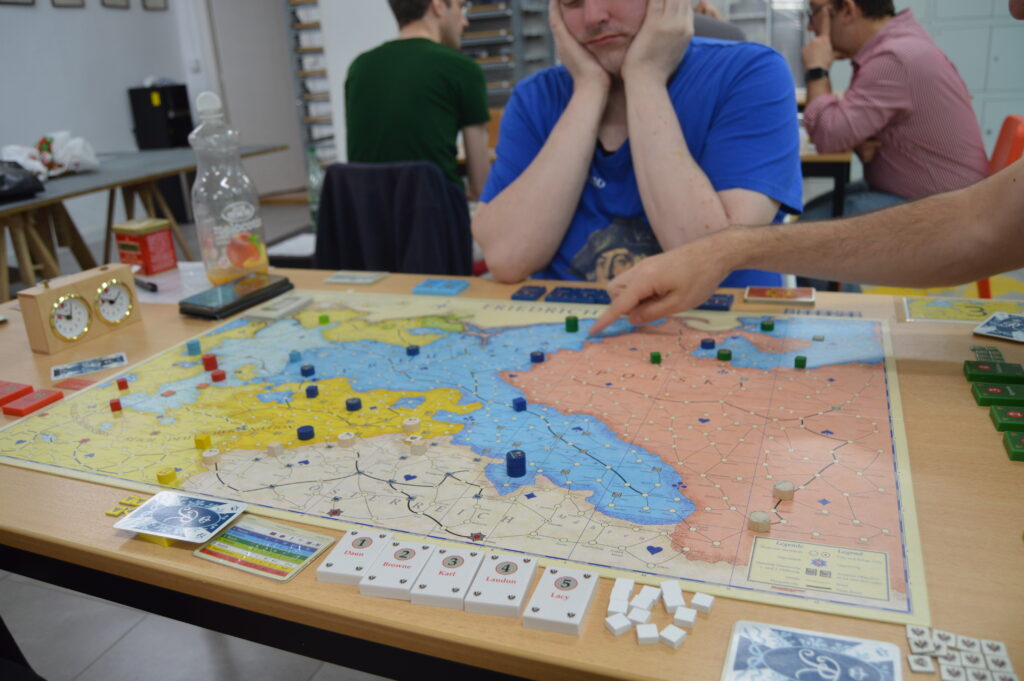
It’s the end of the second prussian turn and Austria has 2 generals thrown out to Poland and 13 troop points less than at the beginning of the game.
Table 3
This game saw the CAFE coordinator – José – playing Austria as an out of contest player and starting the game with a loss of 13 white troops already in the second round. After this resounding victory Arnold’s Prussiansgave ground up in eastern Saxony and defended in hearts against Russia, while the Hanoveriand tried to stop Silvél’s French by themselves with agressive counteratacks. The defense against Russia switched from hearts to clubs as Arnold run out of the first suit. The 2 Austrian generals that suffered the early defeat found their way to Silesia from Poland, while another white general was left in support of Hildi.
Arnold slowly lost more and more ground at every front, harried by an apparent lack of proper card suits to hold long enough at any battle. The game ended in round 16 with a triple victory for Russia (Juan Aguado), Austria, and the Empire.
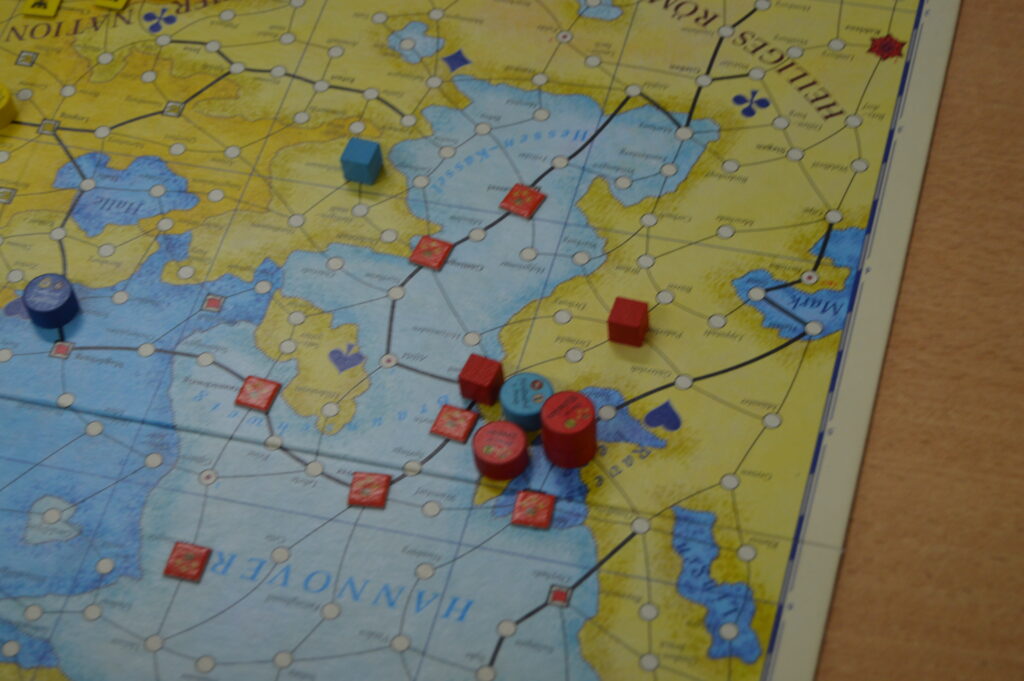
Ferdinand is surrounded by 3 French generals.
Table 4
Guy – who took the Prussians at this table – had to face some early reverses. Lord Bute was the first card of fate to show up, and soon after the French under Mark Luta encircled and destroyed Ferdinand at Minden. But fortune soon began to the former CAFE champion at other fronts. Elisabeth passed away relatively early (round 13) before being able to seriously challenge the Prussian clubs. Carlos and his Austrians waivered long enough in the first rounds to allow a triple tower of Prussians to sit tight at Breslau, while the French were stopped cold with hearts at Magdeburg. The Prussian defense at Silesia finally began to crack when the game suddenly ended in the 22nd round with a Prussian victory.