
[:es]
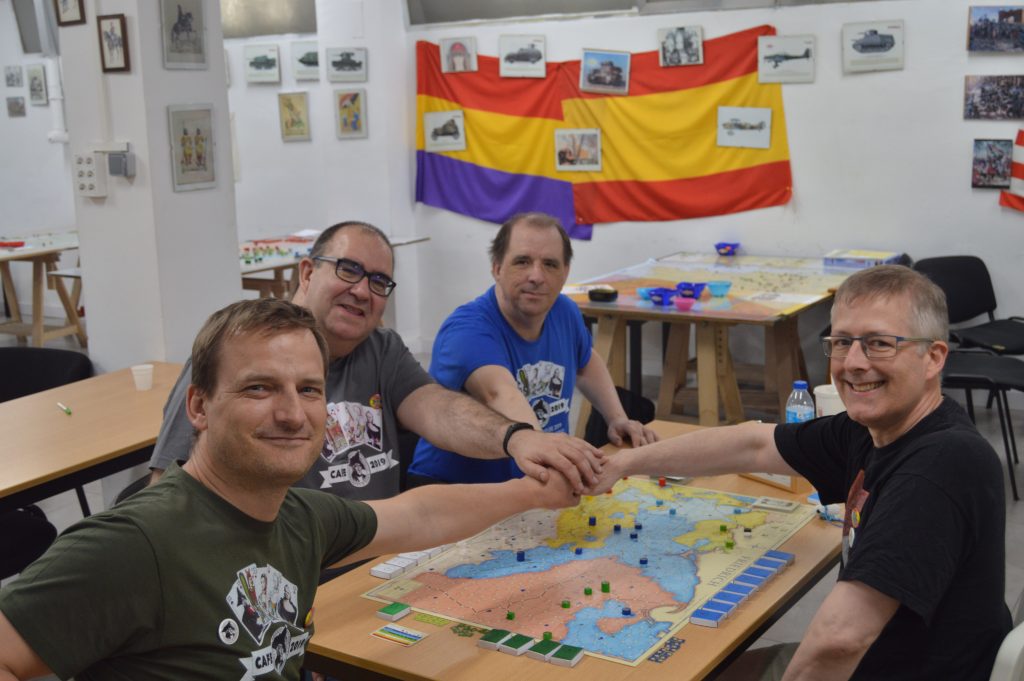
Al comienzo de la partida la atmósfera en la mesa todavía es alegre.
Habiendo concluido aproximadamente a las 16:00 la última partida de la ronda clasificatoria, y tras una breve ceremonia de entrega de diplomas de participación, dio comienzo la partida final de este campeonato a las 16:41 tras sentarse los jugadores de la siguiente forma, en orden descendente según su clasificación en la ronda previa:
- Guy Atkinson, primer clasificado toma asiento como Federico.
- Alberto Romero, segundo clasificado, toma asiento como María Teresa.
- Anton Telle, tercer clasificado, toma asiento como Isabel.
- Björn von Knorring, cuarto clasificado, toma asiento como Madame Pompadour.
Y de esta forma queda constituida la mesa para la final. ¡La partida puede comenzar!
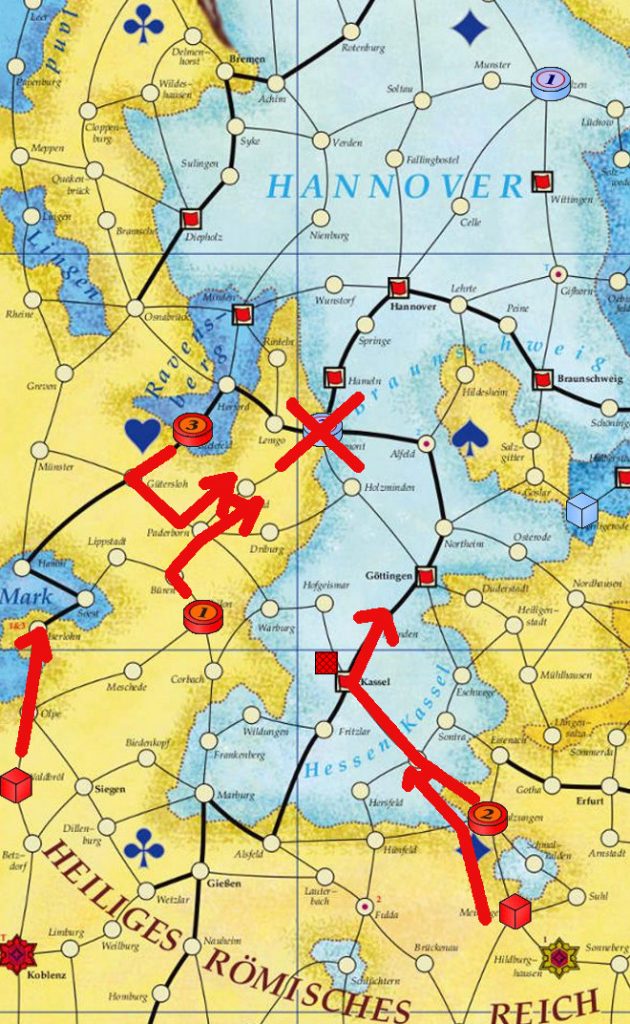
Todos los participantes en la mesa son veteranos de varios campeonatos, con varias finales y trofeos en su haber. Ello hace en cierta manera previsible el transcurso de las primeras rondas. El primer turno hace pensar así. Sin embargo, en el final de la segunda ronda deviene la primera sorpresa. Guy ha adelantando a Cumberland (H2) sobre Pyrmont, retando a los Franceses de Björn a cambiar sus corazones por sus picas, de las cuales el jugador de origen británico se siente muy confiado. Sin dudar, Björn acepta el envite y en el breve intercambio de cartas subsiguiente (no hay muchas cartas, estamos en el turno 2) H2 es eliminado, lo que tendrá consecuencias serias en las rondas siguientes.
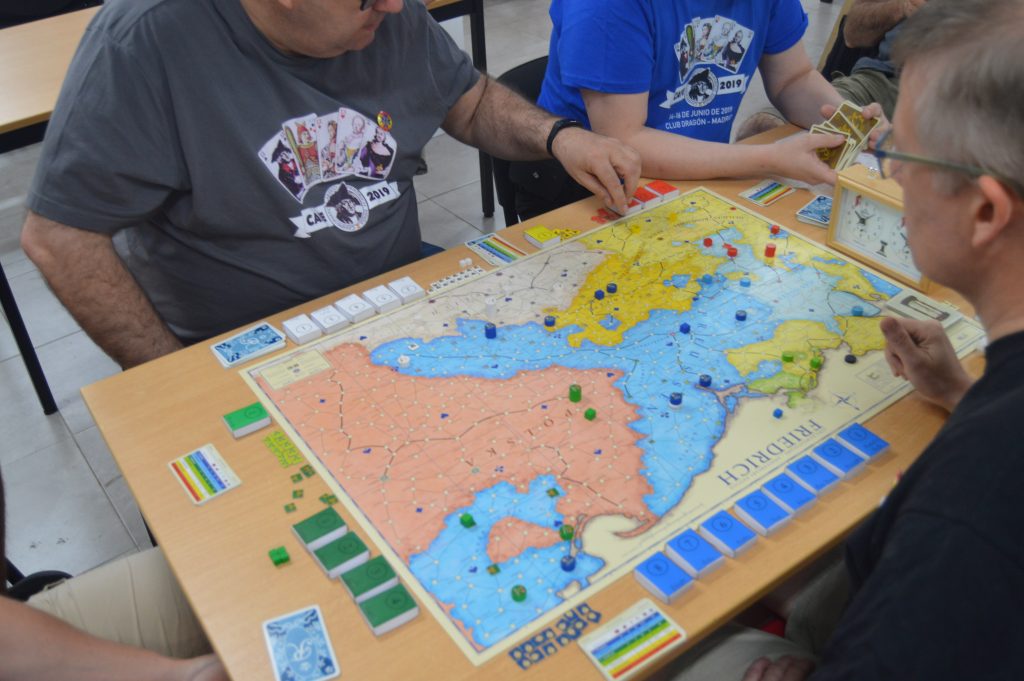
El turno 3 ve los primeros combates en el resto de frentes. Contra Rusia en tréboles R1 y R2 contra P7 en Kammin, que termina en victoria Prusiana por 4 puntos. Otro combate entre tres generales austríacos y P4 y P5 en Silesia se salda con otra victoria Prusiana por 2 puntos de margen. Como se ve, siendo jugadores veteranos, los Aliados no pierden el tiempo en comenzar el acoso a su enemigo común.
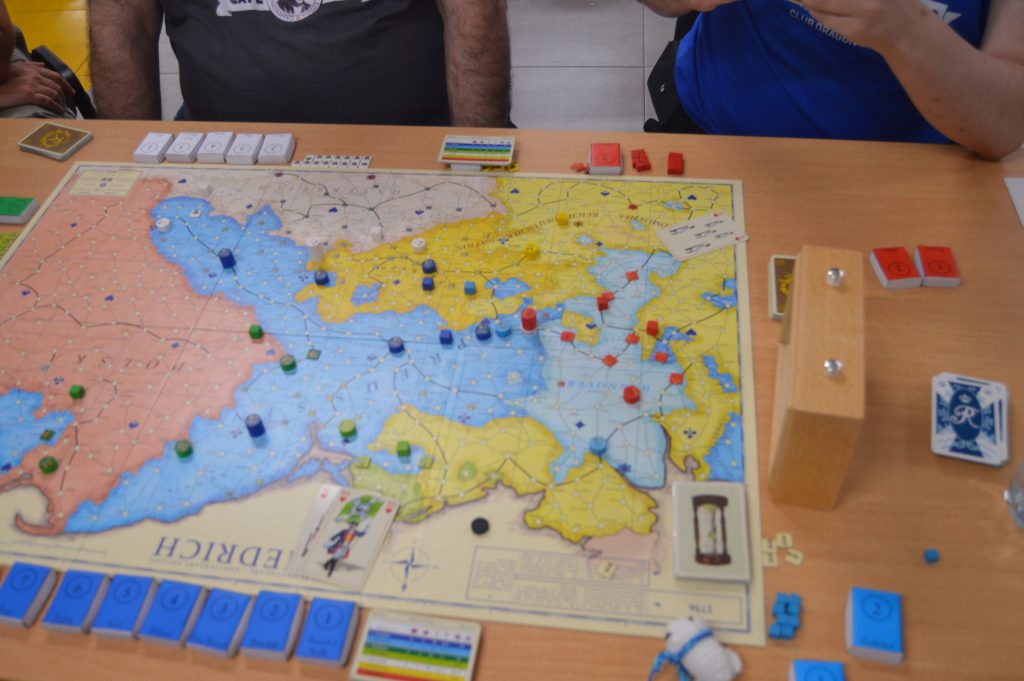
En los siguientes turnos la actividad se relaja por parte de Rusia, que se desvía para tomar Küstrin y elimina a Lehwaldt (P8) de Prusia Oriental mientras acumula más cartas. Alberto, por su parte no persiste en sus ataques con su torre triple de generales, que se desvía hacía el sector de tréboles que une Sajonia y Silesia. ¿Se habrá quedado sin diamantes?. Laudon (A4) aprovecha y toma Cosel en el extremo sudeste de Silesia al tiempo que Browne (A2) se aproxima a Sajonia directamente desde el sur.
No obstante la situación con Francia no tarda en volver a calentarse. Guy ha situado a Ferdinand (H1) sobre Magdeburgo, retando de nuevo a Björn a un combate. Esta vez intercambiando corazones de la mano de Hannover por los de Francia. Y de nuevo Björn acepta sin vacilar. Richelieu y Soubise (F1 y F2) atacan con 16 tropas y otro general hannoveriano es levantado del mapa.
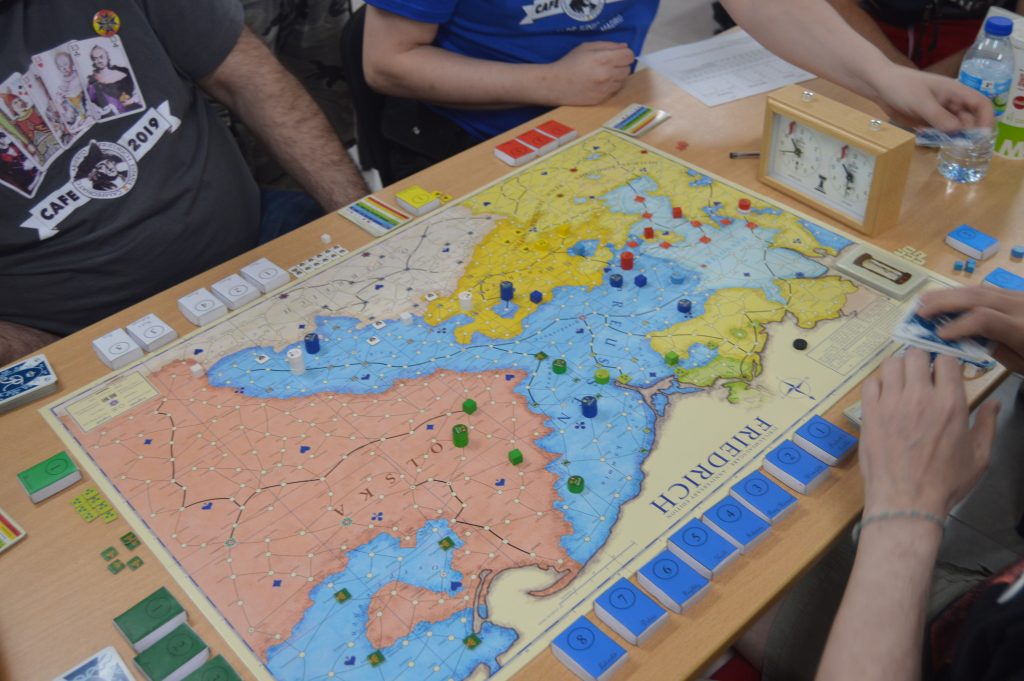
Situación al final del turno 8. La amenaza permanece latente en torno a Magdeburgo, en Sajonia y en Silesia, mientras que Rusia aún tiene que recuperarse de la última derrota sufrida por 5 puntos.
En el turno 6 el par de generales franceses lanza otro ataque sobre Seydlitz (P6) con una gran superioridad (16 tropas frente a sólo 2) que resulta en una retirada Francesa en dos espacios. La destrucción de Cumberland en la segunda ronda se está haciendo notar al serle posible a Björn concentrar una gran fuerza contra un débil general prusiano, lo que obliga a Guy a pagar un alto sobrecoste (14 puntos) en cartas de corazones en cada combate. Ello compensa a Björn de los corazones gastados contra Hanover. Su estrategia ahora parece consistir en aprovechar esta ventaja para intentar tomar Halberstadt y Magdeburgo si consigue agotar los corazones de la mano Prusiana, para después centrarse en Wittingen, único objetivo ha dejado en su retaguardia. Dadas las débiles cartas que está robando Hanover y la pérdida de todas sus tropas, en estos turnos Björn tiene serias posibilidades de ganar. Tan sólo necesita que Guy reciba una pésima mano en corazones…
Mientras esta crisis se preparaba en el oeste, en el este Guy lograba unir a Heinrich (P3) con Dohna (P7) a tiempo para hacer frente a otra ronda de ataques Rusos en los turnos 7 y 8. Dada la concentración de tropas prusianas en estos dos generales (9 puntos) la superioridad numérica Rusa no resultaba muy grande. Anton consiguió intercambiar algunas cartas en tréboles con su oponente sin hacer más mella, a simple vista. Desafortunadamente para él, en esos turnos la actividad de sus aliados se redujo un tanto. Björn cesó temporalmente en sus ataques en corazones. Muy posiblemente por falta de cartas en dicho palo y la tremenda vulnerabilidad que tiene Francia a una derrota severa. Alberto, por su parte, deshizo su apilamiento triple. Un general se dirigió a reforzar el que había en Sajonia, los otros dos regresaron a Silesia desde el oeste para unirse a Laudon (A4) en el turno 8. Guy envía a dos generales a Sajonia para detener el avance austríaco allí y estorbar la conquista imperial de objetivos.
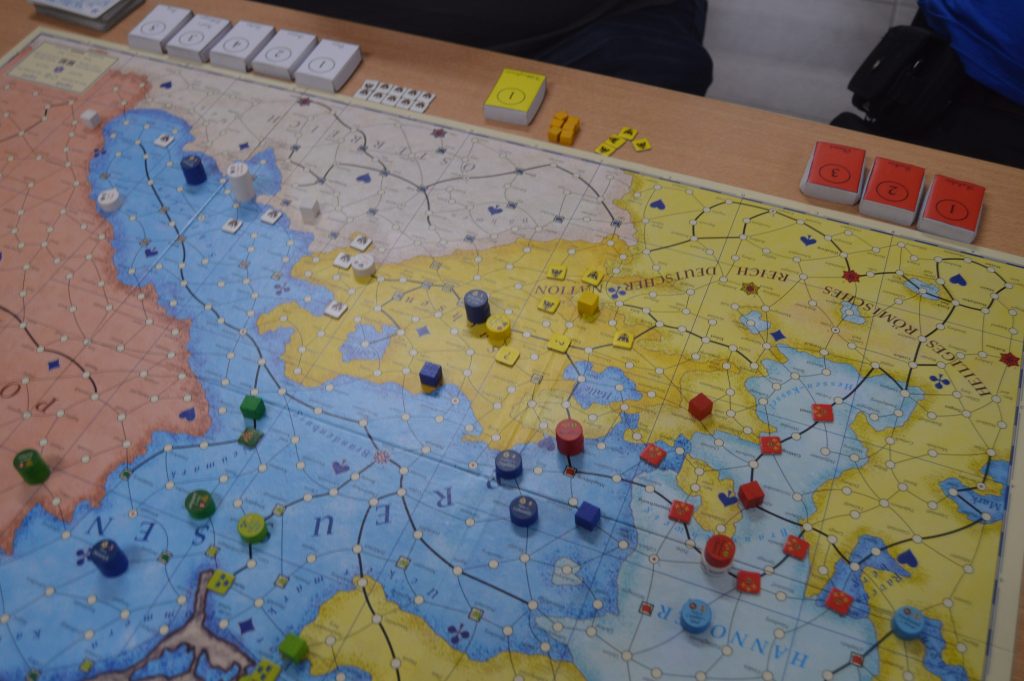
Ataque del Ejército Imperial sobre los Prusianos en el turno 12. En la imagen también se pueden contemplar los diversos centros de resistencia prusiana y la acumulación de fuerzas enemigas en torno a ellos.
Los siguientes turnos fueron testigo de un incremento en la presión aliada, al sucederse constantemente los ataques de Rusia, Austria, y Francia sobre los Prusianos con mayor o menor ventaja numérica y que Guy iba rechazando con un elevado consumo de cartas de su mano, acentuado por la aparición de Lord Bute en el turno 11. Rusia centraba sus ataques sobre P3 y P7 inamovibles en Wangerin. Austria hacía lo propio con su torre de tres generales sobre P4 y P5 en el sector de diamantes de Silesia, mientras que Francia lanzaba sus ataques sobre P6 en Magdeburgo. Bjorn perdió Diepholz a cambio de mantener la presión sobre Magdeburgo. Una decisión no recomendable en una partida clasificatoria pero acertada en la final, en la que no se puntúa nada excepto la victoria. Incluso Hildi se unió al acoso en el turno 12 con un ataque sobre Friedrich y Winterfeldt (P1 y P2) en Sajonia y del que la pieza amarilla sobrevivió maltrecha con una retirada de 4 espacios.
Y fue justo entonces – como en tantas otras ocasiones en este juego – que el Destino golpeó duro. Francia abandonó la partida en el turno 13 (al salir India, América había salido en el turno 10) y un turno más tarde la zarina moría y Rusia también abandonaba la partida. La situación había dado un vuelco y todo parecía ir de cara para Guy cuando el turno 16 compensó, con Poemas, un tanto la debacle aliada. Todo ahora descansaba en las manos de Alberto. ¿Sería él, como el Aliado principal que quedaba en el tablero, capaz de arrancar la victoria de las garras de la derrota?
El foco de la partida se concentra en el sur, en Silesia y Sajonia. El progreso de Alberto en esta partida hasta ahora ha sido lento y metódico, mas finalmente parece hacer mella en Guy, que retira a Schwerin y Keith al cuadrante de tréboles en el extremo suroriental de Silesia para cortar la sangría de diamantes que le suponía hacer frente cada turno a la pila triple de Alberto (Browne, Laudon, y Lacy; A2, A4, y A5 respectivamente) y sus 24 tropas. Guy trae a marchas forzadas generales liberados de otros sectores. A pesar de lo cual parece que Silesia está pérdida, y entonces tiene lugar la jugada decisiva.
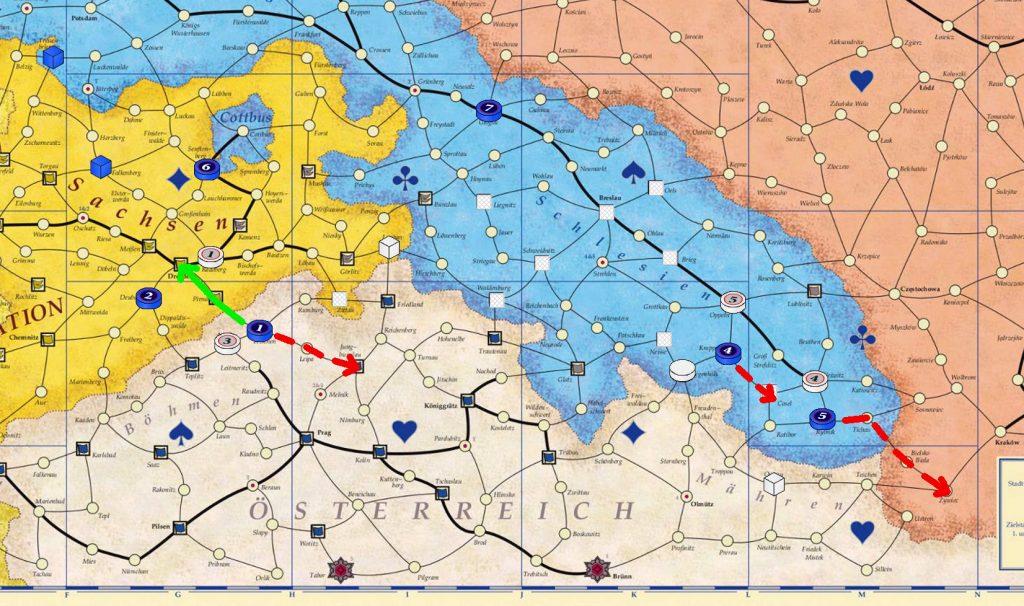
En un intento de decidir la situación a la vez tanto en Silesia como en Sajonia, Alberto lleva a cabo tres ataques en este turno. A4 contra P5. A5 contra P4, y A3 contra P1. De estos tres el que resulta tener un resultado crucial es el último, Karl contra Friedrich, y que concluye con la retirada de este último hasta Jungbunzlau. Ello le pone a tiro del tren de suministro central austríaco, el más crucial para la estrategia de Alberto. En la imagen de arriba se muestran con línea discontinua roja las retiradas efectuadas por Alberto ese turno. La ruta trazada en verde muestra la retirada que Alberto hubiera podido efectuar con P1 para salvar su tren de suministro en Lauban y tener así posibilidades de ganar en las últimas rondas de la partida.
Con la diligencia que le caracteriza, en su turno Guy liquidó ambos trenes de suministro austríacos y creo una nueva amenaza con P7 sobre Liegnitz.
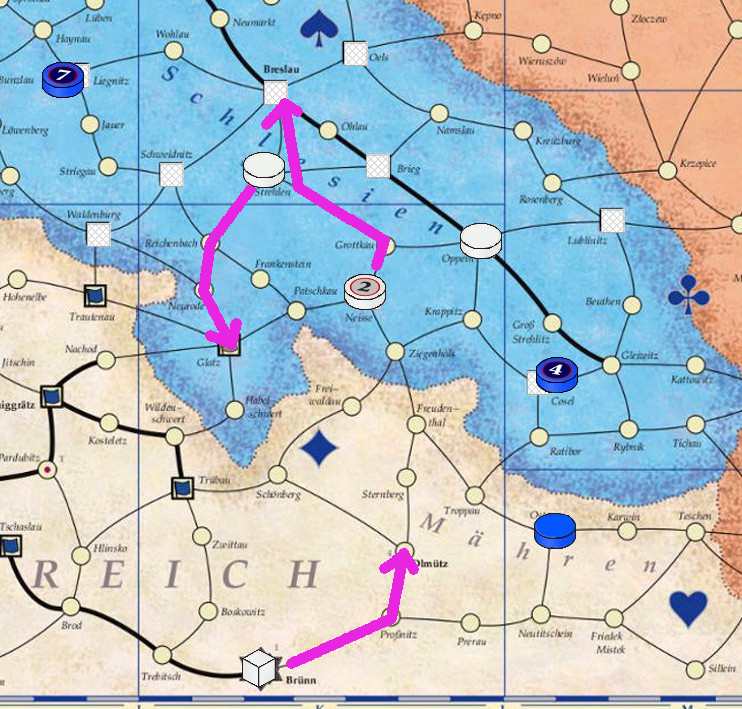
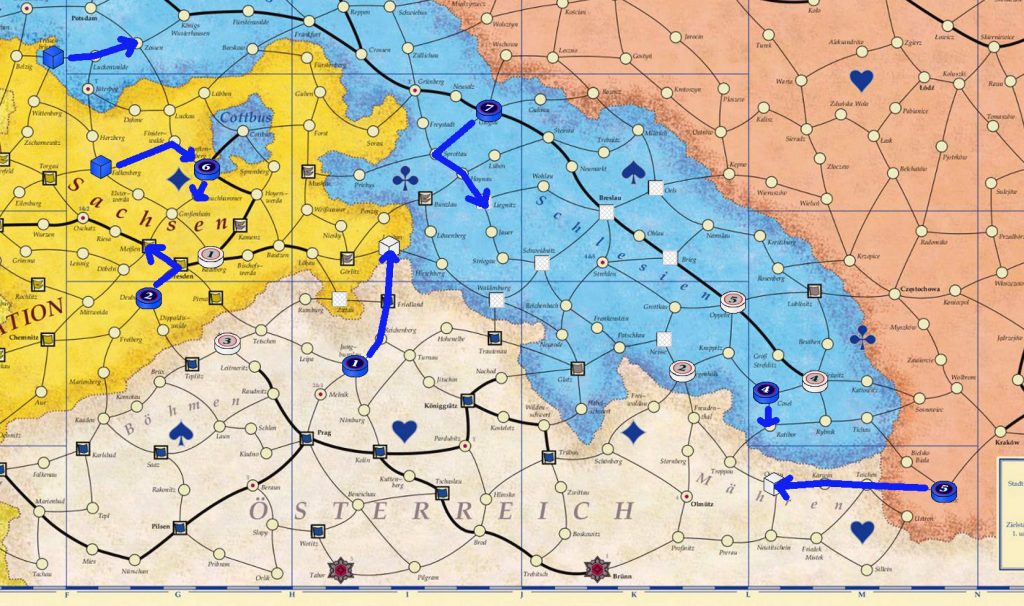
Dos turnos más tarde, Alberto hubiera podido mantener el control sobre este objetivo con A2, si este se hubiera situado en Strehlen o Breslau haciendo de relevo del general austríaco sin suministro que mantenía el control sobre Liegnitz. La situación al inicio del turno austríaco y los movimientos propuestos se muestran en la imagen que sigue.
En lugar de ello, Alberto prefirió tomar Glatz y abandonar Liegnitz, como se muestra en la imagen siguiente.
Este fue un fallo fatal, dado que al haber perdido recientemente ambos suministros, iba a tardar varios turnos en adelantarlos lo suficiente como para retomar Liegnitz, mientras que Glatz estaba de todas formas a su alcance. En el orden de prioridades, mantener Liegnitz era más importante que tomar Glatz. Pero los nervios o el cansancio le impidieron a Alberto la claridad de ideas necesaria.
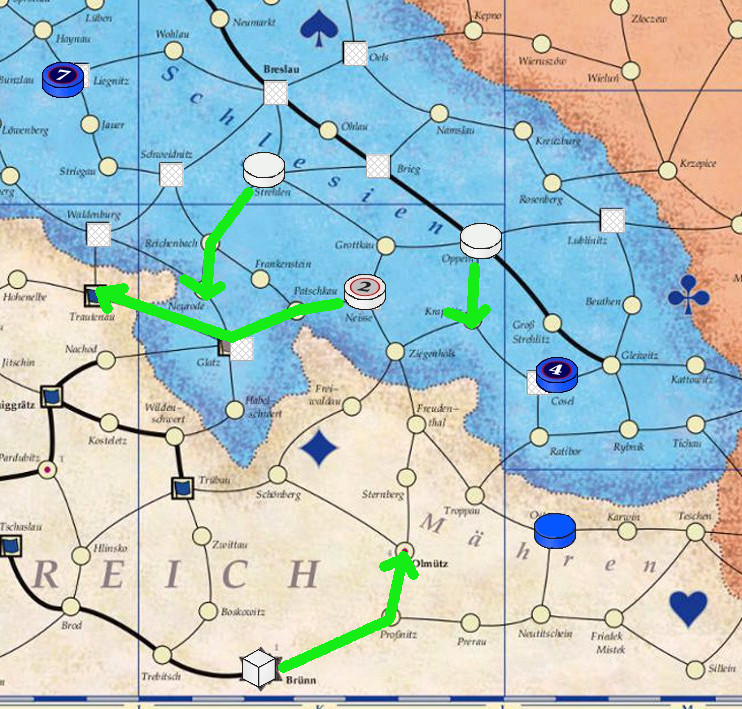
Gracias a su doble eliminación de los trenes de suministro austríacos y al fallo de prioridades de Alberto, Guy tenía la partida firmemente bajo control durante los últimos dos turnos que necesitaba hasta proclamarse, en el turno 21 ganador de la partida y ¡Campeón de España de Friedrich 2019!
ANALISIS RETROSPECTIVO
Guy jugó una partida bastante convencional como Prusia. Esa era precisamente su mejor opción para ganar – por fin – el campeonato: jugar como Prusiano, emplear las estrategias ya establecidas y no arriesgarse demasiado ni probar nada nuevo. Con un poco de suerte – y la tuvo – podía salir triunfante, como así fue.
El único lugar donde intentó algo nuevo – y le salió mal – fue contra Francia, al ofrecer combate con Cumberland en la segunda ronda. Ciertamente consiguió maximizar las cartas de corazón que Björn tuvo que gastar con Francia antes de comenzar a luchar directamente contra Prusia por Magdeburgo, pero al mismo tiempo permitió que dos generales franceses con 16 tropas se unieran contra un único general prusiano con 2 tropas en una serie de ataques muy costosos que, de haberse distribuido las cartas del destino de manera un poco diferente, bien hubieran podido costarle la partida a Guy. Björn, por su parte, se merece el crédito debido por no dudar en hacer el sacrificio necesario para apartar a Hannover de en medio y al poder concentrar fuerzas contra Prusia, convertirse en el jugador aliado con mayores posibilidades reales de victoria durante muchos turnos.
Anton también jugó de forma bastante convencional, y asimismo tampoco se le puede culpar por ello. Barrió Prusia Oriental con rapidez y efectividad, y desde muy pronto se concentró en ataques con superioridad de tropas en el palo decisivo: tréboles. Sin embargo, si algo estaba robando Guy en abundancia este día, eran precisamente tréboles. Anton sólo podía esperar que la suerte del aspirante al título se acabará antes de que Elisabeth muriese. Por desgracia para el dos veces campeón de España, no fue así.
Alberto realmente no cometió ningún error crucial salvo los ilustrados en el reporte en la recta final de la partida. Al mismo tiempo, sus movimientos iniciales fueron algo dubitativos, con la pila triple de generales bailando de un lado a otro sin atacar, y con Laudon aislado en Silesia Oriental. La situación de este último arrastró consigo un tren de suministro austríaco que hubiera sido más útil más al oeste, y además dejó a Alberto sin el general austríaco que necesitaba para apoyar el avance del Imperio o incrementar la presión en Sajonia. En su conjunto fueron pequeños inconvenientes más que errores. Pero en una final de Friedrich tan sólo juegan los mejores, y para aspirar a la victoria hace falta hilar fino.
The last game of the heats ended at about four o’clock and after a brief diploma-giving ceremony, the four finalists took their places in order around the table, ready to play the final.
1. Guy Atkinson, winner of the heats, chose to play as Frederick.
2. Alberto Romero opted for Maria Theresa.
3. Anton Telle decided to play as Elisabeth, leaving…
4. last, but not least, Björn von Knorring as Madame Pompadour.
The players are ready, a group photo and let battle commence!
Given that all the finalists are veterans of various championships and between them have won all the prizes and trophies that can be won, it might be expected that the early rounds would be rather uneventful. The opening turn was standard, but there was a surprise waiting at the end of turn two. Confident of success, Guy had positioned Cumberland (H2) in Pyrmont, daring Björn to trade French hearts for Hanoverian spades. Björn immediately took up the challenge and after a brief exchange (we are in turn two, there aren’t many cards available) H2 comes off the board, an event which will weigh heavily in the coming rounds.
Emboldened, the other allied players wasted no time getting to grips with their common enemy and turn three saw Prussia fighting on all fronts; against Russia in Kammin, where P7 won a four-point victory over R1 and R2 in clubs; and in Silesia P4 and P5 beat off an Austrian triple stack.
Russia spent the next few turns taking Küstrin and eliminating Lehwaldt (P8) to clear East Prussia, all the while accumulating cards for the coming onslaught. Alberto, perhaps for lack of diamonds, did not immediately launch another attack with his triple stack, but instead marched into the clubs sector between Saxony and Silesia. Laudon (A4) took Cosel in tip of Upper Silesia while Browne (A2) closed on Saxony from the south.
The French are in action too. Guy has placed Ferdinand (H1) on Magdeburg, offering combat to Björn once again, this time Hanover’s hearts for those of France. Again Björn attacks without hesitation with Richelieu and Soubise (F1 and F2). Their sixteen troops prevail and another Hanoverian general comes off the board.
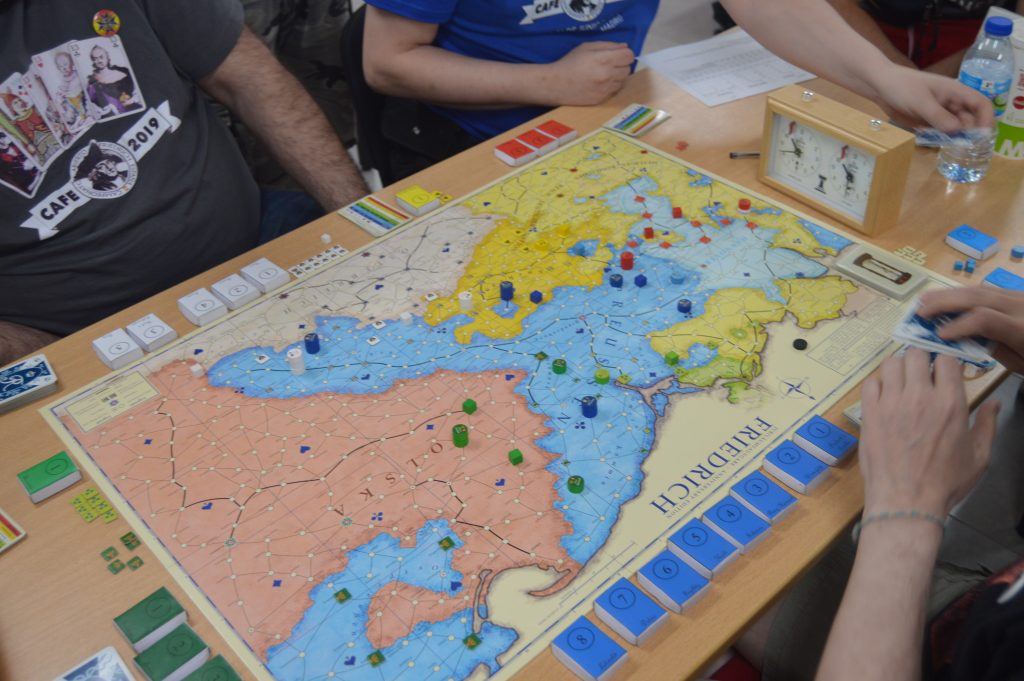
Turn 8: the situation remains threatening around Magdeburg, in Saxony and Silesia, while Russia licks her wounds after suffering a five-point defeat.
The early destruction of Cumberland allows Björn to concentrate two French generals at maximum strength to attack Seydlitz (P6), who only has two troops. By taking small tactical retreats, the French are able to repeatedly make the most of their overwhelming numerical advantage to bleed Guy’s hand of hearts dry, more than making up for the cards spent against Hanover. Björn’s strategy appears to be to take Halberstadt and Magdeburg first before making a final drive to take Wittingen, the last Hanoverian objective still in enemy hands. With Hanover drawing low cards, and hence barely able to replace her heavy losses, Björn has a good chance of winning. He just needs Guy’s hearts to run out…
With this crisis building in the west, Guy managed to stack Heinrich (P3) and Dohna (P7) with nine troops between them in time to face the renewed Russian attacks in turns seven and eight. With only a small numerical advantage, Anton managed to draw some clubs – but not enough to break through. Unfortunately for him, the pressure from the other allies slackened off somewhat. Short of hearts and unwilling to risk exposing his main force to a disastrous rout, Björn withdrew to a safe distance. Alberto split up his triple stack, sending one general towards Saxony while the other two returned to Silesia to join Laudon (A4) in turn eight. Guy sent two generals to reinforce the defence in Saxony to slow the Austrians and prevent the Imperial Army from taking objectives.
The Imperial Army attacks in turn 12. Note the various areas being defended by Prussian forces and the enemy concentrations around them.
Allied exertions increased again during the next few turns, with constant attacks by all the major powers being beaten off, but only at a high price in cards, which the Prussians could ill afford, especially given the appearance of Lord Bute in turn eleven. Russia tried to dislodge P3 and P7 from Wangerin, while Austria pounded P4 and P5 in the diamonds sector in Silesia. To be able to keep his main force concentrated around Magdeburg, Björn allowed Diepholz to be liberated. Perhaps not a good choice in the heats, but the right thing to do in the final, in which only victory counts. Hildi entered the fray in turn twelve, attacking Friedrich and Winterfeldt (P1 and P2) in Saxony, but was driven off with the loss of four troops.
And just then – as so often happens – Fate intervened decisively. India! And France dropped out in turn 13 (America had already appeared in turn 10). Then one turn later the tsarina died and Russia also left the game. The situation had been turned on its head, with just Poems in turn 16 to compensate slightly for the allied débâcle. Everything now laid in Alberto’s hands. Commanding the only remaining allied major power, would he be able to snatch victory from the jaws of defeat?
Attention turned south to Silesia and Saxony. Up to now Alberto had made slow, but methodical progress which finally seemed to be taking effect; Guy was forced to withdraw Schwerin and Keith to the clubs sector in southeast Silesia to end the massive loss of diamonds caused by the 24 troops of Alberto’s triple stack (Browne, Laudon and Lacy: A2, A4 and A5). Despite the imminent arrival of fresh generals freed up from other sectors, Silesia appears all but lost.
Alberto launches multiples attacks, trying to liberate both Silesia and Saxony. A4 versus P5; A5 versus P4 and A3 versus P1. This last combat turns out to be crucial: Karl defeats Friedrich, who retreats to Jungbunzlau, within range of the central Austrian supply train on which Alberto’s whole plan depends. The dashed red lines in the image below show the retreat paths chosen by Alberto; the solid green line another possible retreat for P1, which would have kept the supply train in Lauban out of harm’s way, significantly improving Austria’s chances.
Not one to let such an opportunity go begging, Guy eliminated both Austrian supply trains simultaneously and sent P7 to threaten Liegnitz.
Two turns later, by moving to Strehlen or Breslau, Alberto could have held on to Liegnitz, as shown in the following image.
But instead, he opted to give up Liegnitz and take Glatz.
This was a fatal mistake: with the loss of both supply trains, a number of turns would be needed to recover Liegnitz, while Glatz was always there for the taking. But tiredness and nerves prevented Alberto from seeing things clearly.
Guy now had the game firmly in hand and held out until turn 21 to become Spanish Friedrich Champion 2019!
RETROSPECTIVE ASSESSMENT
Guy played a pretty conventional game as Prussia, which was precisely his best option to be able – at long last – to win the championship. By using the tried and tested strategies and avoiding unnecessary risks, with a bit of luck – which he had – he would triumph, and so he did.
The only new variant, offering combat against France with Cumberland in turn two, ended in disaster. Although Björn had to spend more hearts than usual before attacking Prussia directly, he was able to concentrate two French generals against the lone, weak Prussian general defending Magdeburg and launch a series of attacks, which might well have cost Guy the game had the Cards of Fate fallen differently. Kudos to Björn for rightly continuing to attack Prussia even when the Hanoverians had recovered somewhat. For a number of turns he had real chances of winning.
Anton also played conventionally. He swept through East Prussia quickly and effectively before gathering his forces to attack with numerical superiority in clubs. But Prussia had a very strong clubs hand and unfortunately for the two-times champion, Elisabeth died before Guy’s luck ran out.
Apart from the mistakes made in the final stages, Alberto barely put a foot wrong. Nevertheless, his early moves where perhaps somewhat hesitant, the triple stack marching to and fro without closing on the enemy and Laudon on his own in Upper Silesia and with him a supply train that might have been better employed elsewhere. The Imperial Army was also left to fend for itself without Austrian support and thus unable to exert much pressure in Saxony. Trivial errors maybe, but only the best players reach the final and you need be on top form to have a good chance of winning.